“Myah sounds great, but I don’t need it yet. I’m getting along fine.” We hear this a lot, and it makes sense. Why spend money on something you don’t need? The assumption is that Myah is a response to a problem. This got me thinking: while we’ve built Myah to help prevent problems, is there any evidence that it does? Spoiler alert: yes! Most academic research I found, and the experience of our customers, shows that there are six good reasons to enjoy the benefits of Myah sooner rather than later.
1. It’s useful straight away
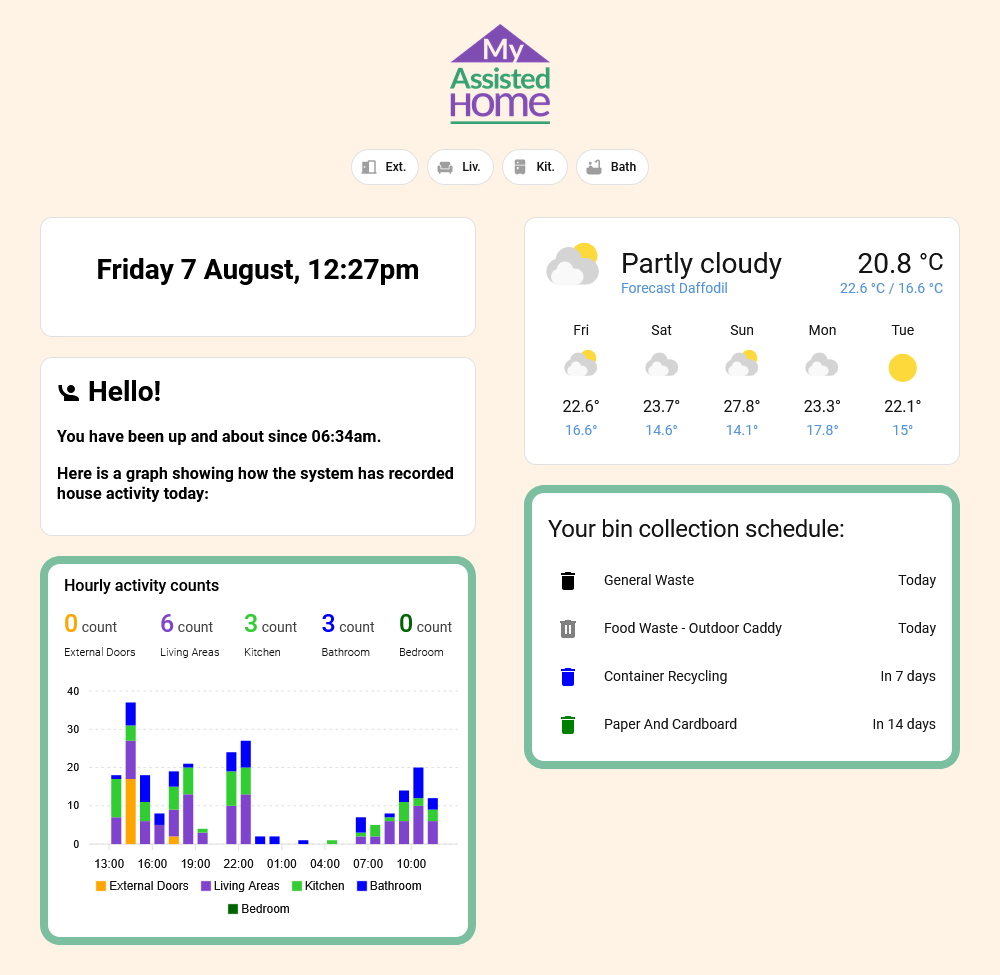
We’ve built Myah to be a helpful assistant from day one, for both the resident and their loved ones (or care circle). The home dashboard offers useful info: today’s weather; which bin goes out; a simple picture of the day’s activity. All with nothing to wear, charge or remember. It also provides a shopping list and care notes features for the care circle.
We’re also working to make Myah even more useful by including further simple smart home ideas like heating control, to deliver a home that looks after you. We see activity monitoring as the start not the conclusion.
2. It gives real assurance
For the person living independently, and for the family keeping an eye from a distance, there’s a genuine reduction in worry that comes simply from knowing the activity picture is there if it’s needed. A telecare pilot write-up found this in practice, 20 years ago: participating families described real peace of mind from the daily activity picture, and the professionals involved described being able to check in usefully without needing to intrude.[1][2]. Most days, most weeks, Myah’s value is simply not having to wonder.
3. You control the change
There’s a real difference between a system that arrives because you chose it, on an ordinary day, with time to get used to it, and one that arrives because a crisis forced the decision. The first allows everyone to be involved, try it, get comfortable, and adjust as needed. The second removes that entirely: the technology, any new routine, and the underlying worry all arrive at once. Choosing when and how something changes gives dignity and control.
4. It’s easier to learn before a crisis
This sits alongside the point above. Learning something new is measurably harder under pressure than it is with time and confidence to spare. A 2018 review of UK-funded telecare research, from the National Institute for Health and Care Research, describes this kind of system working best as a ‘tool for living’, introduced early and lived with, rather than bolted on afterwards once things have already become difficult [3]. The same body of research found the reverse pattern too: people who never took up telecare often described it as a last resort, something you’d only reach for once things had already gone wrong. Waiting doesn’t make eventual adoption easier. It just moves the learning curve to the moment everyone involved has the least spare capacity to face it.
5. It builds a baseline to measure against
If a dashboard only starts recording activity the week something feels off, there’s nothing to compare it to. Is this week quieter than usual, or is that just an ordinary Tuesday for this particular household? You can’t tell, because there’s no baseline yet. Time in the background builds the comparison you’d otherwise be missing, because the system started before it was actually ‘needed’.
The telecare pilot BT ran in Liverpool showed exactly this in practice [1,2]. The daily activity profiles it built up over time let carers and family spot things like a sudden change in bathroom visits – an early flag for a possible infection – well before it became urgent. The system knew what normal looked like for that particular person – and that takes time to establish.
It is also true that our day-to-day health isn’t predictable. A cold might knock the stuffing out of us or a sprain make activities harder than usual. With activity monitoring in place the impact can be understood and provisions made.
6. It shows the bigger picture.
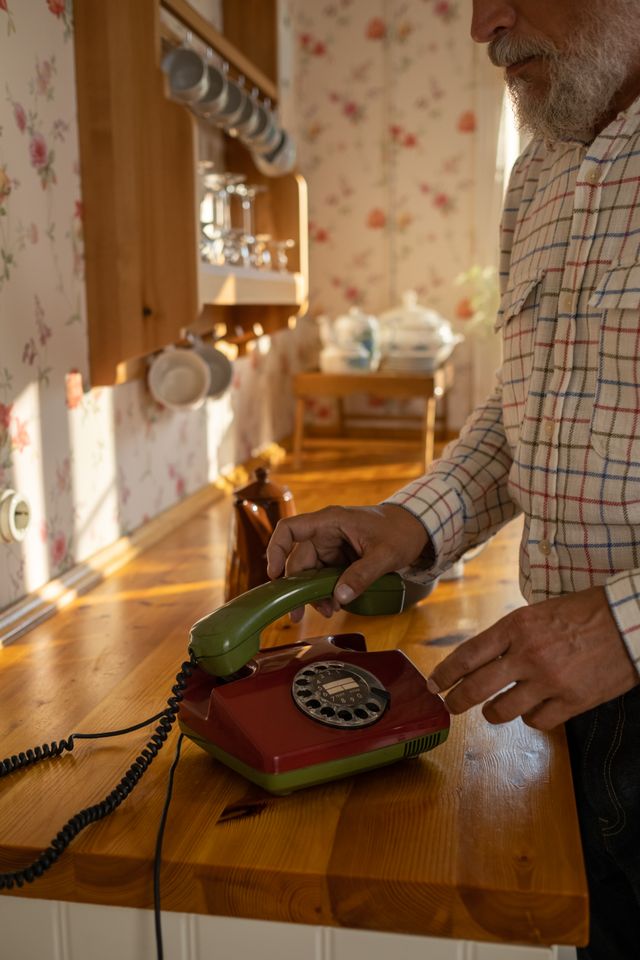
“I’ll notice if something changes, we speak every week.” Phone calls are genuinely valuable; especially for social contact. But a phone call is a curated account of the week, not a measurement of it. Whoever answers chooses what to mention, usually with the entirely kind intention of not worrying the person on the other end. It’s a snapshot the person has had time to compose, not a neutral reading of how the week actually went.
A Japanese academic study of family perception of cognitive change, the Toyama dementia survey, found that family members consistently noticed changes later than the older relative noticed them in themselves. By the time family had picked up on it, things had already progressed beyond a stage where early support could help [4]. A weekly call relies on someone either noticing something themselves or choosing to mention it. An ongoing activity picture relies on neither.
Conclusions
So, six solid reasons to not delay purchase of a product like Myah.
A final question we hear is “Will this delay admission to a care home?“
Since the days of the Liverpool trial, passive monitoring tools have become commonplace in formal social care settings to assess care package needs or support hospital discharge. We’d love to tell you that’s evidence Myah will delay admission to a care home. Sadly, the formal evidence isn’t clear cut; the most rigorous UK trial built to test this among diagnosed dementia patients found no clear effect between different types of telecare[5]. However, it didn’t compare telecare with having nothing at all. We think that the widespread use of passive monitoring systems in social care is a strong indicator of benefit compared with not having the tools. What tools like Myah can genuinely do is report activity levels and help carers spot changes, giving real information to support choices to reduce preventable crises.
What starting now actually means
Reassurance for everyone involved starts building from day one, rather than a new, unfamiliar, thing arriving at the exact moment it’s needed most. The pace of change stays with the person and their family, not with events. Everyone grows accustomed to a new tool while it’s easy, not once it’s urgent. A picture of what normal actually looks like begins forming, ready for whenever it’s genuinely needed. And the helpful, easy-to-use smart features for day-to-day support are there from day one.
If you are ready to purchase now, try our online shop. As a thank you for reading this article, use this code to get a £50 discount, THANKYOU-50OFF Offer ends on 20-Sep-26.
If you’d like to see how it works before deciding anything, we’re always happy to talk it through on a free demo call, no obligation.
References
A note on sourcing: all references below are peer-reviewed academic papers or a National Institute for Health and Care Research-funded synthesis, not vendor or product marketing material. Where a study’s population, comparison, or method differs from Myah’s own product or audience (for example, ATTILA’s dementia-diagnosed cohort, or WSD’s focus on telehealth for long-term conditions rather than ambient activity monitoring), that’s noted inline in the article itself rather than only here.
- Barnes N, Webster S, Mizutani T, Ng J, Buckland M, Reeves A. Liverpool Telecare Pilot: case studies. Journal of Innovation in Health Informatics (Inform Prim Care), 2006;14(3):197–202. doi: 10.14236/jhi.v14i3.631. Pilot run by BT with Liverpool City Council, deployed to 21 frail/elderly social services clients over two years. https://doi.org/10.14236/jhi.v14i3.631 (also at https://pubmed.ncbi.nlm.nih.gov/17288706/ and https://doaj.org/article/1ed0d570bd824fe2b6df79550f0cc047) ↩︎
- Buckland M, Frost B, Reeves A. Liverpool Telecare Pilot: telecare as an information tool. Journal of Innovation in Health Informatics (Inform Prim Care), 2006;14(3):191–196. doi: 10.14236/jhi.v14i3.630. https://doi.org/10.14236/jhi.v14i3.630 (also at https://pubmed.ncbi.nlm.nih.gov/17288705/ and https://doaj.org/article/4bb36ec4e438472b90ad257fa164df47) ↩︎
- National Institute for Health and Care Research (NIHR) Dissemination Centre. Help at Home: Use of Assistive Technology for Older People, 2018. A themed review synthesising UK research funded by NIHR and other government funders. https://evidence.nihr.ac.uk/themedreview/help-at-home-use-of-assistive-technology-for-older-people (full PDF: https://content.nihr.ac.uk/nihrdc/themedreview-03345-HH/Help-at-home-WEB.pdf) ↩︎
- Nakahori N, Sekine M, Yamada M, Tatsuse T, Kido H, Suzuki M. Discrepancy in the perception of symptoms of cognitive decline between older adults and their family members: results of the Toyama dementia survey. BMC Neurology, 2019;19:333. doi: 10.1186/s12883-019-1581-2. University of Toyama, Japan; surveyed 663 older adults aged 65+ living with family in Toyama Prefecture. https://pmc.ncbi.nlm.nih.gov/articles/PMC6933887/ ↩︎
- Gathercole R, Bradley R, Harper E, et al. Assistive Technology and Telecare to maintain Independent Living At home for people with dementia: the ATTILA RCT. Health Technology Assessment, 2021;25(19):1–156. doi: 10.3310/hta25190. NIHR-funded randomised controlled trial; found no statistically significant difference in time to institutionalisation between a full assistive technology/telecare package and a basic package. https://www.journalslibrary.nihr.ac.uk/hta/HTA25190 ↩︎
Leave a Reply